1. Measure the faucet
You swing ten times around the 1,000-ft mark and record an average of 15 coins per hit. With no multipliers, the projection is simple: 30 minutes at 2 swings per minute is 60 swings, so the session mints 60 × 15 = 900 coins.
Measure what one swing pays you, apply the multipliers the game officially documents, and project your next session down to the coin — including how many swings your next Skill upgrade really costs.
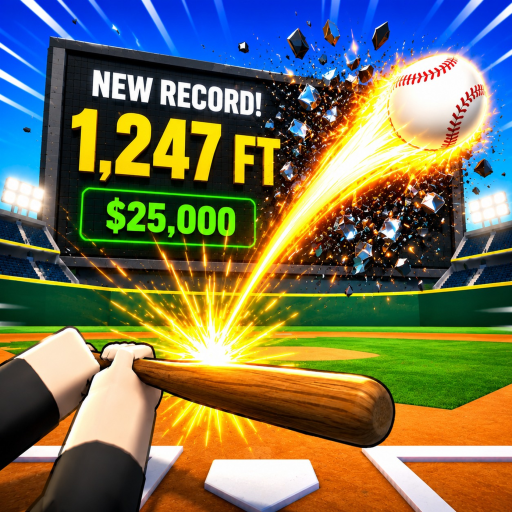
Hit Home Runs has a single currency and a single faucet: hits pay coins, and the official description makes distance the lever — "Hit home runs for coins … Upgrade your Skills … Hit the ball farther." The fan guide states the same doctrine plainly: coins come from hits, and farther hits pay more. That makes a coin plan a three-number calculation — what one swing pays you, how many swings your session holds, and which multipliers are active. The multipliers are not guesses: the game's own pass record documents VIP at +10% coins earned, the 2x Coins pass at double everything, and Stat Saver on the spending side at 25% off each Skill upgrade. Measure, multiply, project.
Your numbers, your plan
Swing ten times, write down what each pays, and enter the average — the projection uses only your numbers.
Add a coin goal from your in-game upgrade screen to see the swings it costs.
Multipliers are the two the game documents in its own pass text: VIP "+10% added to coins earned" and 2x Coins "earn double the coins for everything". Stat Saver changes upgrade prices, not earnings, so it is deliberately absent here.
Hypothetical numbers chosen to show the arithmetic — the tool runs on your own measurements.
You swing ten times around the 1,000-ft mark and record an average of 15 coins per hit. With no multipliers, the projection is simple: 30 minutes at 2 swings per minute is 60 swings, so the session mints 60 × 15 = 900 coins.
Add VIP (+10%) and the 2x Coins pass: 15 × 1.1 × 2 = 33 coins per hit, and the same 60 swings now mint 1,980 coins — 2.2× the base session, exactly the product of the two documented boosts. This is why the multipliers are worth their price tags for daily grinders.
Your next Skill upgrade shows a price on your screen — say 1,000 coins. At 33 per hit that is 31 swings, about 15 minutes at your pace. The session funds the upgrade twice over, and the upgrade raises every future hit: the faucet grows as you drink from it.
From the official description and the game-pass record, checked 2026-10-06.
The hitting stat the game's own pass text describes as the force behind every swing: the +25% Power Boost pass grants "25% more power in every swing you take, permanently", and VIP adds a permanent +5% power on top.
The second named stat. The +25% Contact pass (August 23, 2026) grants "a 25% buff to your contact stat" and states that the buff is permanent and "stacks with all other in-game buffs" — official confirmation that stat buffs stack.
The official game description's third line — "Upgrade your Skills" — is the coins sink: stat upgrades bought with coins. The Stat Saver pass takes "25% on each stat upgrade" off the price, confirming upgrades are priced per stat.
Every hit pays coins, and distance drives the payout — "Hit home runs for coins" per the official description; the fan guide's summary is that coins come from hits and farther hits pay more. VIP adds +10% to coins earned and the 2x Coins pass doubles them.
Because the game pays per hit based on your distance and stats, and the developer displays that number only on your own screen. Any site quoting a universal coins-per-hit rate for Hit Home Runs would be guessing. The tool takes the honest route: you measure ten hits, enter the average, and the arithmetic runs on your numbers.
Watch your coin counter right before and right after a swing at your current best distance, and repeat ten times. The counter tick is your per-hit payout at that distance. Enter the average — and re-measure after each Skill upgrade or stat change, because the payout moves with every upgrade.
The two the game documents in its own pass text: VIP adds "+10% added to coins earned" and the 2x Coins pass means "earn double the coins for everything" (both official pass descriptions, checked 2026-10-06). Stat Saver is not an earning multiplier — it takes 25% off each stat upgrade purchase, so it belongs on the spending side of the plan.
Open the Skill upgrade screen and use the price of your next upgrade as the goal — that is what the projection's swings-to-goal line is for. Badges are the other goal type: clearing the next distance rung raises every future hit's payout, so a rung-shaped session often beats a price-shaped one.
Streaks are the consistency layer: the badge record pays at 10, 25, 50, 100, 150, 300, 500, 750, and 1,000 home runs in a row, so a steady 2-swing-per-minute pace with no misses out-earns a faster pace that keeps dropping the streak. Plan pace you can hold, not pace you can touch.
Set the next badge rung as the session's real goal.
Session structure, streaks, and the grinding doctrine behind the math.
Every documented reward channel, from coins to the Season Pass track.
Data pages on this site cite the official Roblox records for Super Fun Sport Games's experience — the full register is on the sources page.